

Building Better Chemistry: A Student’s Quest for Greener Drug Synthesis
A Lehigh undergraduate is reimagining how we make pharmaceuticals — one colorful molecule at a time.
When Matthew Reeves first walked into Elizabeth Young's physical chemistry lab as a Lehigh freshman, he thought he was heading toward a career more suited to studying solar cells and renewable energy. Fast forward to his senior year, and he's elbow-deep in a completely different challenge: finding cleaner, more efficient ways to synthesize compounds that might one day become life-saving medications. His journey illustrates a truth about scientific discovery — sometimes the best research paths emerge from unexpected turns.
Reeves' senior thesis focuses on oxadiazepines, organic compounds sharing structural similarities with benzodiazepines, the drug class including Valium and Xanax. While benzodiazepines are well-established medications for anxiety, seizures, and sleep disorders, their chemical cousins remain frustratingly difficult to produce.
His research explores whether a particular chemical reaction can work with azo dyes and investigates whether light-induced shape changes in these molecules can help drive reactions forward. This methodology could open avenues to diverse libraries of medically valuable ring-shaped molecules previously difficult to synthesize.
The challenge lies in forming a specific bond between two nitrogen atoms. Previous methods required extreme temperatures — sometimes 240 degrees Celsius— and harsh, toxic reagents, yielding only 14 percent usable product.
Reeves reversed the conventional approach. "Previous work made one bond first, then the other," he explains. "My approach reverses that order and uses a completely different strategy. This process is greener, more efficient, and uses standard reagents," Reeves says. "I tried to pick solvents that were more environmentally friendly, avoiding things like dichloromethane and dimethylformamide that the industry is trying to phase out because they're carcinogenic or otherwise environmentally toxic."
His process starts by mixing compounds with a colorless, crystalline solid to create a reactive intermediate, then adding this to another compound with a mild base. After reacting at cold temperatures for two hours and subsequent purification, he treats the product with another base in a different solvent.
The results are impressive. Reeves achieved 43 percent overall yield — more than triple existing methods' efficiency. The reaction proceeds at room temperature with relatively benign chemicals and offers a visual indicator: orange starting material transforms to bright yellow product.
"There's complete conversion to this product, which is something that doesn't happen too often in organic chemistry. So, it's an improvement, and then what I'm looking to do is explore how general that strategy is," Reeves notes with understated pride.
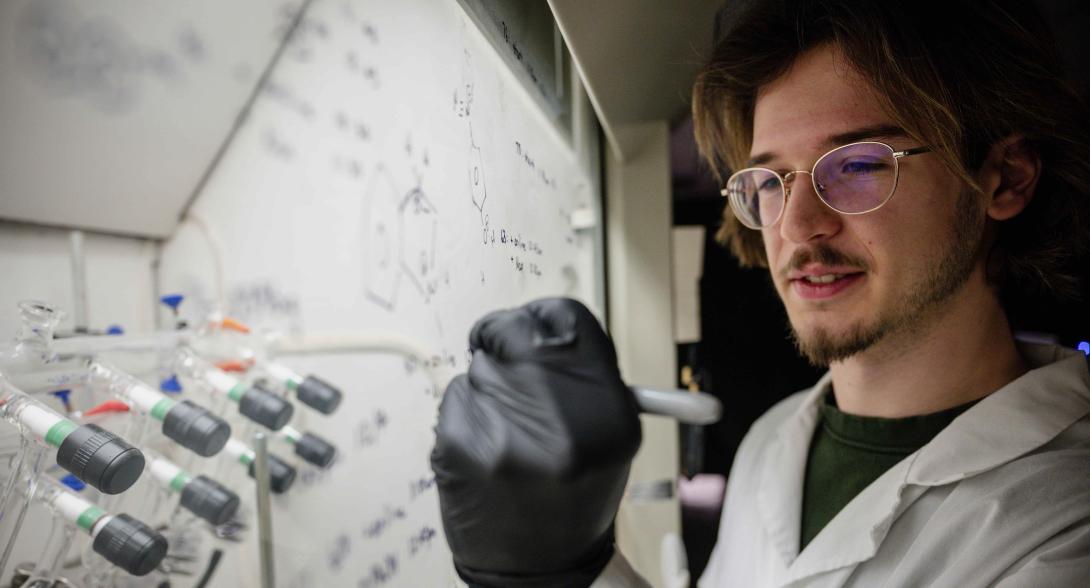
What makes this approach particularly sophisticated is its potential connection to photochemistry. Azo compounds can flip between different shapes when exposed to light. Reeves hypothesizes this light-induced configuration change could enhance reaction efficiency by positioning reactive groups closer together. Pharmaceutical companies might eventually use LED lamps instead of energy-intensive heating—a genuinely green synthetic approach.
His planned experiments would use ultraviolet-visible spectroscopy to monitor reactions in real-time, comparing transformation rates under specific light wavelengths versus darkness. This hypothesis-driven investigation could open entirely new avenues for sustainable drug manufacturing.
Reeves didn't develop these ideas in isolation. Last summer, he interned at pharmaceutical giant Boehringer Ingelheim, working on asymmetric synthesis—methods for producing specific molecular orientations critical to drug efficacy. The experience yielded a publication in Organic Letters with a second paper in preparation.
More importantly, the internship clarified his direction as a chemist. His initial thesis idea — creating metal complexes with azo dyes — felt forced and unfocused. At Boehringer Ingelheim, he saw how to bridge the azo dye chemistry from Young's lab with the practical methodology development used in pharmaceutical production.
In an era when sustainable practices increasingly shape pharmaceutical development, Reeves's work represents exactly the innovation the field needs—transforming harsh conditions into mild reactions and toxic waste into green synthesis.